Ive added my 2 nodes to the satellite and did a test upload and it’s working.
Do your satellites support multipart upload on the s3 endpoint?
Please consider BSC or TRX chain.
As I understand if I am currently joined to the test satellite, then I will automatically join the new one, correct?
Yes, I restarted my nodes and the new satellite automatically showed up.
I’m running the same software as Storj, they support it on both gateway-st and gateway-mt, so yes (y).
When storkspace token? 
All my nodes joined the new satellite automatically. Happy that you got it (almost) complete! 
with a multi million premine again? ^^
It is not just email.
How to set unique email, wallet address coin network (and maybe other settings that I cannot think of right now) per satellite and in a way that it exposed to the specific satellite operator and not to any satellite operator?
That would require a code change.
I just changed my wallet and email address for all satellites before joining the new test satellite. That way I was able to hide my payout history from the test satellite. Just for safety. I feel comfortable to change that back. Well not the wallet address. I had to renew that one anyway.
Oh I now notice I did not remove my email address. I just replaced it with my work email. If it gets leaked its less compromising for me than my personal email address. So I am good. No need to change anything.
Then I guess that’s something that should be done. Information that a SNO shares with one satellite operator is none of the other operators’ business.
Threw my 7 nodes into the mix, I had one on the test but threw all 7 on now.
For payouts, my feedback would to mirror what Storj used to do with the ZKSync payouts a bit. You can opt into another chain, but if you don’t there would be a much higher minimum payout.
In my case I’m not a crypto person, so the benefit of lower gas fees doesn’t outweigh the work to maintain tokens on a secondary chain. I’m also totally fine waiting for a minimum amount of earnings to accumulate before a payout takes place. I get though that others may not feel that way and at the scale of running a full satellite gas fees add up much faster than my 3 transfers a year.
Is it possible to join only satellite sj.storkspace.net:1111 but not tutor.storkspace.net:7777?
How do I (graceful) exit tutor.storkspace.net:7777 if my node got disqualified?
Yes, instead of:
storage2.trust.sources: https://www.storj.io/dcs-satellites,https://static.storkspace.net/dcs-satellites
You can do this:
storage2.trust.sources: https://www.storj.io/dcs-satellites,storj://1yjgPDnv1XRSh6emyQA2VZP1nquivTN8usC2BkFYDL2BbGB2nH@sj.storkspace.net:1111
Not sure actually, I don’t have experience with disqualified, think it is already gone? Do you even need to exit it?
Let’s say I’d rather start with a new node rather than adding to an existing node. Is there the usual vetting + holding period? Or would all nodes, including existing nodes be subject to that, so no difference?
Yes, there is no different (at least for now), all nodes join new satellite will subject to vetting + holding period.
Hi @mattventura, here is stats for these satellites, https://stats.storkspace.net/, it will update once a day (retry several times a day if somehow fail).
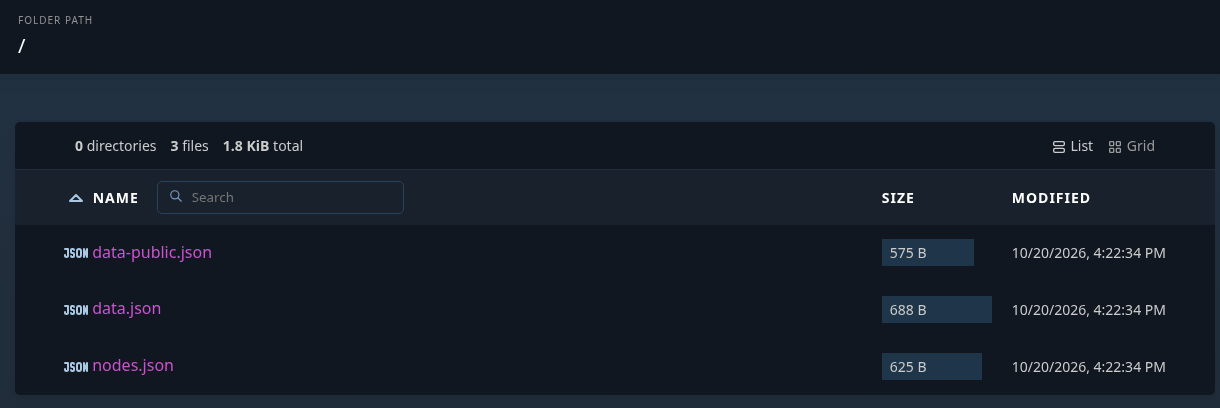
storj_stats.py
#!/usr/bin/env python3
"""Generate data.json, data-public.json and nodes.json (stats.storjshare.io style)
from satellite databases running on CockroachDB.

Every query reads historical data with AS OF SYSTEM TIME '-10m' (configurable
with --as-of) to avoid contention with live writes. The "last 30 days" and
"4 hour online" windows are relative to now(), which differs from the read
time by only ~10 minutes.

Usage:
    pip install "psycopg[binary]"
    python3 storj_stats.py --config config.toml --out ./out
    python3 storj_stats.py --config config.toml --as-of -30s
    python3 storj_stats.py --print-sql            # show the queries, no DB needed

Requires Python 3.11+ (tomllib).
"""
from __future__ import annotations

import argparse
import json
import os
import re
import sys
import tempfile
import tomllib
from decimal import Decimal
from pathlib import Path

# --------------------------------------------------------------------------
# Queries. {asof} is replaced by the --as-of value (validated, e.g. -10m).
#   pb.PieceAction: PUT = 1 (upload), GET = 2 (download)
#   placement 0 / NULL = every country = public placement
# --------------------------------------------------------------------------
AOST = "AS OF SYSTEM TIME '{asof}'"

Q_STORAGE = f"""
SELECT
    COALESCE(SUM(total_bytes), 0)           AS storage_total_bytes,
    COALESCE(SUM(object_count), 0)          AS storage_total_objects,
    COALESCE(SUM(remote_segments_count), 0) AS storage_total_segments
FROM bucket_storage_tallies {AOST}
WHERE interval_start = (SELECT MAX(interval_start) FROM bucket_storage_tallies)
"""

Q_BANDWIDTH = f"""
SELECT
    COALESCE(SUM(settled + inline) FILTER (WHERE action = 2), 0) AS bandwidth_bytes_downloaded,
    COALESCE(SUM(settled + inline) FILTER (WHERE action = 1), 0) AS bandwidth_bytes_uploaded
FROM bucket_bandwidth_rollups {AOST}
WHERE interval_start >  now() - INTERVAL '30 days'
  AND action IN (1, 2)
"""

# Run on the METABASE database. redundancy is a little-endian packed int8:
# byte4 = required shares, byte7 = total shares.
Q_EXPANSION = f"""
SELECT
    COALESCE(SUM(
        encrypted_size::numeric
        * ((redundancy >> 56) & 255)
        / NULLIF((redundancy >> 32) & 255, 0)
    ), 0)::bigint AS storage_total_bytes_after_expansion
FROM segments {AOST}
WHERE remote_alias_pieces IS NOT NULL
  AND (expires_at IS NULL OR expires_at > now())
"""

Q_STORAGE_PUBLIC = f"""
SELECT
    COALESCE(SUM(t.total_bytes), 0)           AS storage_total_bytes,
    COALESCE(SUM(t.object_count), 0)          AS storage_total_objects,
    COALESCE(SUM(t.remote_segments_count), 0) AS storage_total_segments
FROM bucket_storage_tallies t
JOIN bucket_metainfos b
  ON b.project_id = t.project_id AND b.name = t.bucket_name
{AOST}
WHERE t.interval_start = (SELECT MAX(interval_start) FROM bucket_storage_tallies)
  AND COALESCE(b.placement, 0) = 0
"""

Q_BANDWIDTH_PUBLIC = f"""
SELECT
    COALESCE(SUM(r.settled + r.inline) FILTER (WHERE r.action = 2), 0) AS bandwidth_bytes_downloaded,
    COALESCE(SUM(r.settled + r.inline) FILTER (WHERE r.action = 1), 0) AS bandwidth_bytes_uploaded
FROM bucket_bandwidth_rollups r
JOIN bucket_metainfos b
  ON b.project_id = r.project_id AND b.name = r.bucket_name
{AOST}
WHERE r.interval_start >  now() - INTERVAL '30 days'
  AND r.action IN (1, 2)
  AND COALESCE(b.placement, 0) = 0
"""

Q_NODES = f"""
WITH n AS (
    SELECT
        *,
        (disqualified IS NOT NULL)                              AS is_dq,
        (disqualified IS NULL AND exit_finished_at IS NOT NULL) AS is_exited,
        (disqualified IS NULL AND exit_finished_at IS NULL)     AS is_live
    FROM nodes
)
SELECT
    COUNT(*) FILTER (WHERE is_live AND last_contact_success >  now() - INTERVAL '4 hours') AS active_nodes,
    COUNT(*) FILTER (WHERE is_dq)                                                                          AS disqualified_nodes,
    COUNT(*) FILTER (WHERE is_exited)                                                                      AS exited_nodes,
    COUNT(*) FILTER (WHERE is_live AND last_contact_success <= now() - INTERVAL '4 hours') AS offline_nodes,
    COUNT(*) FILTER (WHERE is_live AND (unknown_audit_suspended IS NOT NULL
                                        OR offline_suspended IS NOT NULL))                                 AS suspended_nodes,
    COUNT(*)                                                                                               AS total_nodes,
    COUNT(*) FILTER (WHERE is_live AND vetted_at IS NOT NULL)                                              AS vetted_nodes,
    COUNT(*) FILTER (WHERE is_live AND free_disk >= 0 AND free_disk < 5000000000)                          AS full_nodes,
    COUNT(DISTINCT wallet) FILTER (WHERE is_live
                                   AND last_contact_success > now() - INTERVAL '4 hours'
                                   AND wallet <> '')                                                       AS active_wallets
FROM n {AOST}
"""


def sql(template: str, asof: str) -> str:
    return template.format(asof=asof).strip()


def validate_asof(value: str) -> str:
    if not re.fullmatch(r"-\d+(ms|s|m|h)", value):
        raise argparse.ArgumentTypeError("use a negative interval such as -10m, -30s or -1h")
    return value


def to_jsonable(v):
    if v is None:
        return 0
    if isinstance(v, Decimal):
        return int(v)
    return v


def fetch_row(conn, query: str) -> dict:
    with conn.cursor() as cur:
        cur.execute(query)
        cols = [c.name for c in cur.description]
        row = cur.fetchone()
    return {c: to_jsonable(v) for c, v in zip(cols, row)}


def collect(sat: dict, asof: str, skip_expansion: bool) -> dict:
    import psycopg  # imported here so --print-sql works without the driver

    data, data_public, nodes = {}, {}, {}

    with psycopg.connect(sat["satellitedb"], autocommit=True) as conn:
        data.update(fetch_row(conn, sql(Q_STORAGE, asof)))
        data.update(fetch_row(conn, sql(Q_BANDWIDTH, asof)))
        data_public.update(fetch_row(conn, sql(Q_STORAGE_PUBLIC, asof)))
        data_public.update(fetch_row(conn, sql(Q_BANDWIDTH_PUBLIC, asof)))
        nodes.update(fetch_row(conn, sql(Q_NODES, asof)))

    if sat.get("metabase") and not skip_expansion:
        with psycopg.connect(sat["metabase"], autocommit=True) as conn:
            data.update(fetch_row(conn, sql(Q_EXPANSION, asof)))
    else:
        data["storage_total_bytes_after_expansion"] = None

    # keep the same field order as the published page
    order = [
        "bandwidth_bytes_downloaded", "bandwidth_bytes_uploaded",
        "storage_total_bytes", "storage_total_bytes_after_expansion",
        "storage_total_objects", "storage_total_segments",
    ]
    data = {k: data[k] for k in order}
    return {"data": data, "data_public": data_public, "nodes": nodes}


def write_json_atomic(path: Path, obj) -> None:
    path.parent.mkdir(parents=True, exist_ok=True)
    fd, tmp = tempfile.mkstemp(dir=path.parent, prefix=path.name, suffix=".tmp")
    try:
        with os.fdopen(fd, "w") as f:
            json.dump(obj, f, indent=2)
            f.write("\n")
        os.replace(tmp, path)
    except BaseException:
        os.unlink(tmp)
        raise


def print_sql(asof: str) -> None:
    sections = [
        ("data.json: storage [satellitedb]", Q_STORAGE),
        ("data.json: bandwidth [satellitedb]", Q_BANDWIDTH),
        ("data.json: storage_total_bytes_after_expansion [metabase]", Q_EXPANSION),
        ("data-public.json: storage [satellitedb]", Q_STORAGE_PUBLIC),
        ("data-public.json: bandwidth [satellitedb]", Q_BANDWIDTH_PUBLIC),
        ("nodes.json [satellitedb]", Q_NODES),
    ]
    print(f"-- Every query reads AS OF SYSTEM TIME '{asof}'\n")
    for title, q in sections:
        print(f"-- {title}\n{sql(q, asof)};\n")


def main() -> int:
    ap = argparse.ArgumentParser(description=__doc__, formatter_class=argparse.RawDescriptionHelpFormatter)
    ap.add_argument("--config", default="config.toml", help="TOML file listing satellites (default: config.toml)")
    ap.add_argument("--out", default="out", help="output directory (default: ./out)")
    ap.add_argument("--as-of", dest="asof", type=validate_asof, default="-10m",
                    help="AS OF SYSTEM TIME offset (default: -10m)")
    ap.add_argument("--skip-expansion", action="store_true",
                    help="skip the slow metabase scan; storage_total_bytes_after_expansion becomes null")
    ap.add_argument("--print-sql", action="store_true", help="print the queries and exit")
    args = ap.parse_args()

    asof = args.asof

    if args.print_sql:
        print_sql(asof)
        return 0

    with open(args.config, "rb") as f:
        cfg = tomllib.load(f)
    sats = cfg.get("satellite", [])
    if not sats:
        print("error: no [[satellite]] entries in config", file=sys.stderr)
        return 2

    print(f"reading AS OF SYSTEM TIME '{asof}'", file=sys.stderr)

    out = {"data": {}, "data_public": {}, "nodes": {}}
    failed = False
    for sat in sats:
        url = sat["url"]
        print(f"[{url}] querying...", file=sys.stderr)
        try:
            res = collect(sat, asof, args.skip_expansion)
        except Exception as e:  # report every satellite, then fail as a whole
            failed = True
            print(f"[{url}] FAILED: {e}", file=sys.stderr)
            continue
        for k in out:
            out[k][url] = res[k]

    if failed:
        print("not writing any file because at least one satellite failed", file=sys.stderr)
        return 1

    outdir = Path(args.out)
    write_json_atomic(outdir / "data.json", out["data"])
    write_json_atomic(outdir / "data-public.json", out["data_public"])
    write_json_atomic(outdir / "nodes.json", out["nodes"])
    print(f"wrote data.json, data-public.json, nodes.json to {outdir}/", file=sys.stderr)
    return 0


if __name__ == "__main__":
    sys.exit(main())
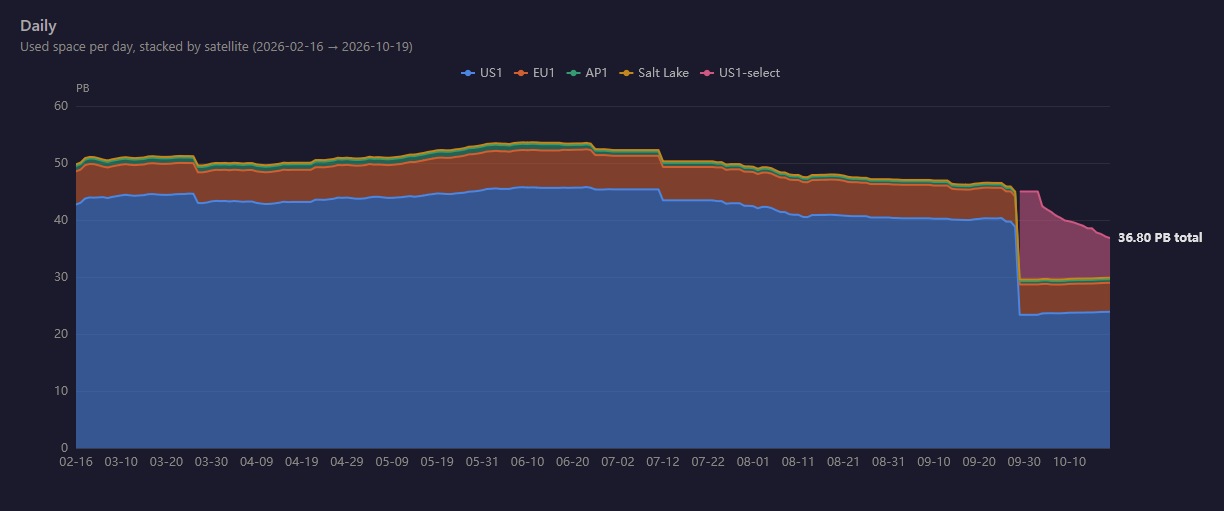
You’re in luck: you can grab it from GitHub
I’d want to focus on marketing and get the name out there instead, any help is much appreciated!
Just joined some of my nodes, the other nodes will join if everything goes well.
I know its a bit early. But if you are gone use something else then the Ethereum blockchain. How do we set a wallet address when we also use the nodes for Storj who already uses the WALLET parameter? Are you gone introduce a custom parameter/tag?