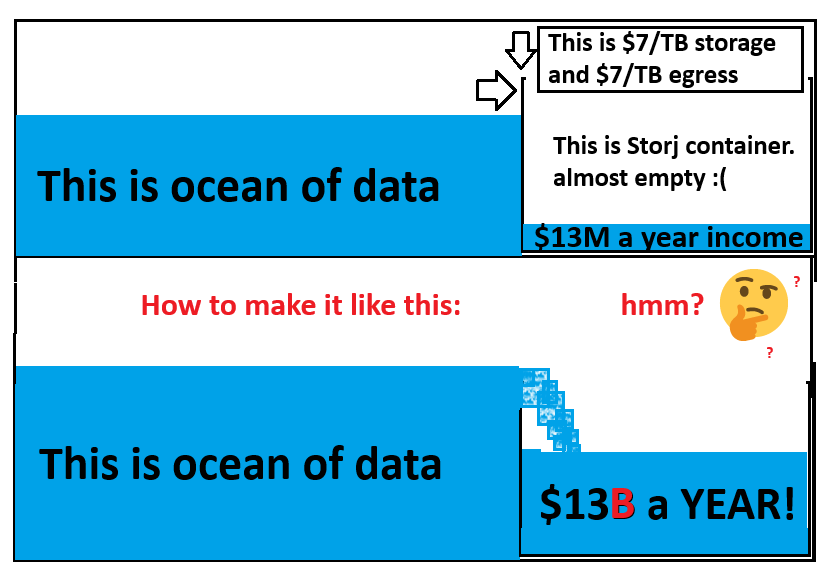
Speaking for myself, my nodes are very small, 5TB x 2. It is the allowable free space I have to offer the project. Calculating all other costs are minimal to say the least. But if a hard drive fails, then so does the node. I will not be able to replace it with a similar size drive based on the costs of today. So my node would go away. The value of a StorJ token was 5 US Cents this morning when I looked it up. That is a far cry from the 30 cents it was a year ago.
While I hope StorJ will continue to operate, I feel that us little guys are going to go away. The folks who run datacenters, will likely stick around, they probably have TiB galore on always running systems while they already factor in the cost of hardware replacements and probably have cases of hard drives laying around.
My current electrical cost is 10.65 cents per kWh. I’ve earned $35 USD in the past year, most of it when I started, before the value of a token dropped. I don’t see it being viable to me anymore, but I plan to stick around and see how this Chapter 11 goes, and cross my fingers.
@littleskunk is there some random figure going around? I’m sure you probably cannot comment while StorJ is in its current position.
Local transfer sometimes just sell-the-drive, yes. Network transfers basically boil down to geography: within-NA or within-Europe can be fast and you just move disk images (it’s OK for the node to be down a few days). But transfers across the Atlantic can be s l o w : and you really need to use rsync for the sender to keep the node alive (otherwise downtime would be too long). In those cases the receiver typically sends compensation per-node before each sync starts.
Transatlantic could take months to move a PB… but the sender would continue to earn for each node still online.
Many SNOs have tons of spare capacity: no need to buy another PB. Like Th3Van has almost 2PB free: he may be interested if you’re serious about leaving. Or msg me (but I’m in North America)
Unfortunalty yes. It looks like leadership has copied my numbers even though I flagged them as not enough data for a decision. My payout data would allow me to continue with a 20% cost saving and thats what they put into the spreadsheet for now. It is a place holder. I can still push back on that number (or make it worse) but I need some real data for that. What is not going to work is any other pushback idea people are trying so far. We can’t change the current situation we are in. Team is down to just the bare minimum to maintain the service.
One positive signal is that we might be able to drop the /24 restriction. In my case that would allow me to reduce my costs by 10% and I can pass that cost saving back to storj.
So please fill out the calculator. If the /24 restriction makes a difference for your caculation please signal which result is with and which one without the /24 restriction. That would help a lot to keep the service running long term.
Drop the /24 restrictions you have been preaching for years - for now reason (people circumventing this, and it is the only reason you have a network lol).
If the /24 restriction is dropped, I can actually work with a 20% payment cut.
That is usable for me. And a decent way to keep my 1.5PB space on the network.
Payout I would guess ~$750 last month?
For maintenance I will go with 10 replacement drives per year and I would assume you know where to get them for like 15€ per TB once the price drops again. So 3000€ per year. Might be a bit high but feel free to fill out the calculator yourself. Result with the /24 rule in place would be:
My Storj node payout tiers — rate cut I could absorb (setup private):
• Survival: −55% → $0.67 / $0.89 per TB
• Barely sustainable: −17% → $1.24 / $1.65 per TB
And with the /24 restriction removed:
My Storj node payout tiers — rate cut I could absorb (setup private):
• Survival: −65% → $0.52 / $0.69 per TB
• Barely sustainable: −27% → $1.09 / $1.45 per TB
In your picture you are missing the storage node payout and infrastructe costs. I haven’t seen recent numbers. Halve a year ago it was like close to $5 per TB used space. With cost reductions I believe we should be somewhere around $4 now. This would be with no support and oncall etc
Dropping the /24 would be a big incentive for me to stick this out. My main concern (beyond reducing payouts) is customers reading all this turmoil and you losing them. If you lose big customers then we all lose big here (and that on top of potentially reduced payouts).
I think one of the biggest mistake Storj made is disrespecting small customers and small storage requirements and trying to go all in with big ones. It’s the small developers that someday become company influencers and help drive buying decisions.
What cold go down is data repair costs, simply made some nodes that will deal purely with repair. It will be compensated by traffic but low price per/tb
Repair can be all done in RAM, no hdd. It can be ruled by Storj Audit servers.
Audit operators can be some contractors. I think even some Select operators can fill that role. Today i think you pay a lot for servers and traffic.
My Storj node payout tiers — rate cut I could absorb (setup private):
• Survival: −75% → $0.37 / $0.49 per TB
• Barely sustainable: −51% → $0.74 / $0.98 per TB
• Slow growth: −14% → $1.29 / $1.72 per TB
• Moderate growth: +23% → $1.84 / $2.45 per TB
(− = reduction from today’s rates · storage $/TB · egress $/TB · scaled together per RS balance)
Removing the /24 would result in:
My Storj node payout tiers — rate cut I could absorb (setup private):
• Survival: −83% → $0.26 / $0.34 per TB
• Barely sustainable: −66% → $0.51 / $0.69 per TB
• Slow growth: −36% → $0.96 / $1.27 per TB
• Moderate growth: +0% → $1.51 / $2.01 per TB
(− = reduction from today’s rates · storage $/TB · egress $/TB · scaled together per RS balance)
It seems to me that many people are circumventing the /24 rule, which endangers the network as they dont know what nodes actually shouldnt have the same pieces. Removing it would show them which nodes really share the same location.
Also im considering the current growth as slow.