Rightsizing Storj Network Payout Rates

They sound unrelated. Like Storj could acheive month-by-month profitability… and still determine their unused-space buffer is much larger than they need. So the correct business decision would be to trim payments a bit more. They’d move from being a-little-bit profitable to a-little-bit-more-profitable, hooray! :money_mouth_face:

If “all the cost savings are working” that’s good: maybe the battles will be with legacy creditors and getting them to accept new payment plans? 75% sounds good… but the courts move so slow they may not make any meaningful decisions until next year.

Yes, that’s exactly what I was asking.
I know profitability and SNO compensation are technically separate issues. What I want to know is whether “all the cost savings are working” also means that further cuts to SNO compensation are no longer considered necessary as part of the restructuring… or whether that is still a realistic possibility.

That distinction matters quite a lot to me/a few/some/many SNOs.

Periodically re-evaluating the cost of your inputs, and price you charge customers… is “steady state” for a business, isn’t it? Storj has changed customer pricing and SNO payouts several times - I’d be astonished if they don’t consider more changes in the future.

Maybe you’re asking how often they plan to look at payouts? What do you think is reasonable? I wouldn’t be surprised if they allowed 3-6 months for any changes to become visible in SNO capacities. Maybe during CH11 three-month decisions would be OK?

The idea to have the nodes with higher occupation is nice until you notice that between month and month your occuped space is not growing. Just receiving data as hell and then a bloom filter that set you at the starting point.

I dont know if more people are in the same situation like me but downgrading the payments I only get more traffic, more deletions and less STORJ/USDC

I think you’re basically right that periodically re-evaluating pricing and payouts is normal business practice, and of course I wouldn’t expect Storj to promise that SNO payouts will never change again.

What I’m trying to understand is more about the current direction and mindset.

Historically, Storj didn’t treat SNO compensation purely as “how far can we push this down before operators leave”. There were statements about payouts being sustainable for the foreseeable future, testing, looking at capacity changes, operator behaviour, etc. So I don’t think it’s unreasonable to ask whether, despite CH11, that mindset still exists.

If the current cost savings are working and the company becomes more stable again, then “we no longer need further SNO cuts” is one possible outcome. And in the longer term, if things improve enough, even increasing payouts again would theoretically be just as valid a business decision as cutting them.

So I’m not really asking how often payouts should be reviewed. I’m asking whether, based on the current restructuring and the improvements they’re seeing, further cuts are still something SNOs should realistically expect, or whether the situation has become stable enough that this risk has decreased as well.

In the same way that “75% or more” wasn’t a guarantee, but still gave us a useful indication of how things currently look, I’d simply like the same kind of non-binding indication about SNO compensation — whether, as things stand today, further cuts still seem likely or whether Storj feels the current cuts are probably enough.

@asturking Yes, my nodes aren’t getting any fuller either. Just a lot of traffic, but there was so much traffic that at least the payment cut for the last month was covered.

But of course, that effect will stop, and in 1–2 months we’ll directly feel the blue balls.

Customer data is declining at similar speed like node count. Repair traffic aside not much happened so far. I guess it needs more substantial cuts for right sizing.

A few of my nodes are shrinking. I’ve lost a few TBs here and there.
The current situation is unlikely to lead to lots of people trust the Storj network with their data…


This will be @littleskunk saying his nodes are growing :grinning_face_with_smiling_eyes:

I don’t have the fancy graphs of other people: but last month things were growing at about double the rate of previous months. Will that stop soon when the repair system catches-up with the GEs? Maybe…

There was just 19 days no bloom filter

What we learned out of this is that it needs to be an recuring exercise. If I look at the list of nodes that left the network I would call it success. 2 weeks ago we lost like 1000 nodes all operated by just 3 operators. At the other end of the scale single node operator have a higher utilization now. So kind of exactly what we have been hoping for.

I can’t make a prediction right now. I can still see nodes leaving the network. It will take more time until we can see the end result. I would like to see a close to empty repair queue for a week or so and than I can give you an estimate. For now I am going to say we are moving in the right direction.

I also have to point out one downside. My previous message that the cost savings are working also means further reductions are totally worth it. A month ago I thought 5 additional cents is just 5% payout reduction. Is it really worth it? Now we can see in our numbers that the answer would be a yes. That doesn’t mean we plan to do further payout cuts. It only means if the metrics we use for rightsizing the network suggest an additional step there wouldn’t be an argument against it.

Maybe the good news in all of this is that we don’t factor in any additional payout cuts right now simply because it takes at least 1-2 additional months before we can see the end result. We have other plans how we can get out of chapter 11.

Indeed they are. About 10% since August. Technically 15% but I lost a node in September so the end result is just 10%.

Yeah, Im at 17% since august, 10% if you discount the trash increase since. Should be accurate, I think bloom filters hit recently.

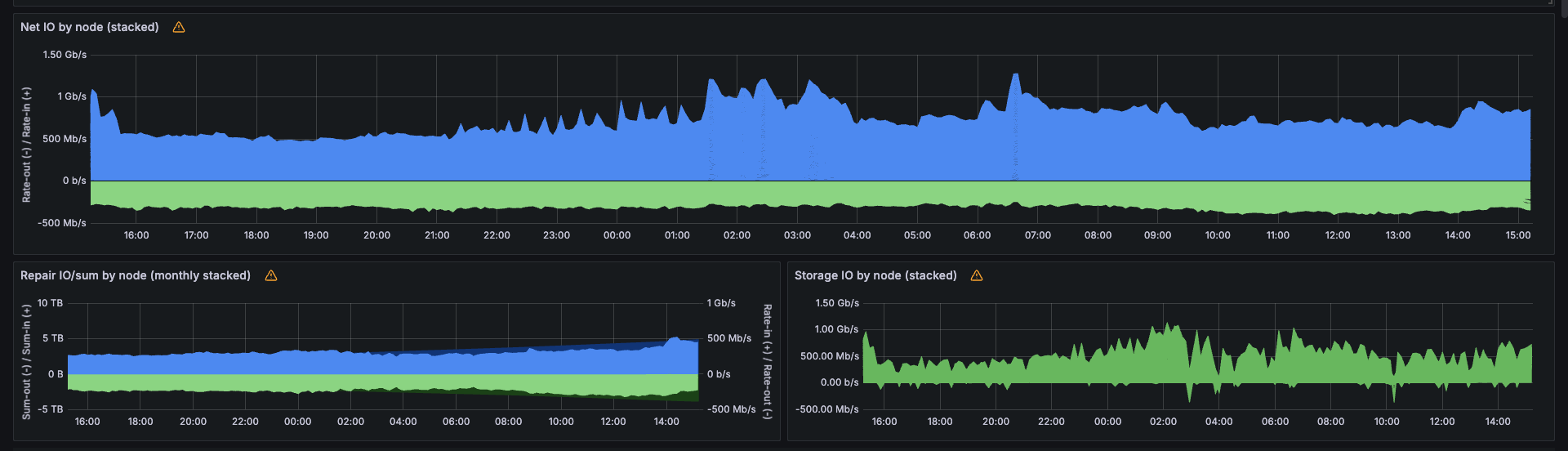
Having crunched more numbers, my servers at home seem to be growing about 100GB/day but by far the most amount of traffic currently is going on repairs. This morning was nuts :slight_smile:

Out of curiosity, does Storj still perform routine benchmarks to check if the recent changes to the network do not negatively affect network performance? Less nodes is not just less storage, but also less total bandwidth and smaller variety of node locations after all.

I wonder if they’d even get valid benchmarks now: they may need to wait for the Repair system to calm-the-f-down :laughing: . Last time I peeked at any logs about half the ingress and a third of the egress was all repair puts/gets.

Eh, it’s as valid as ever. Repair jobs are a natural part of the system.

Repair jobs absolutely pinning node uploads for days-at-a-time isn’t natural. You can’t benchmark expected customer performance when so many Internet connections can’t squeeze in another byte. But it will eventually catch up.

That being said: I’m not complaining nodes are being kept busy :money_mouth_face:

A couple of weeks ago I posted some satellite stats and the expansion factor over all satellites was 1.63 (29 of 47). I know it’s only a ballpark figure, but today it’s 1.75 (29 of 50.6), so the network appears to be in better health.

Well, is this the production network? If so, any measurement on the production network is a valid observation for the customer. We shouldn’t wait until optimal conditions that will maybe happen, the customer is not interested in that. The customer should be interested in how the network operates the moment they need to depend on it, which is, hopefully, right now.