I think, we can close this thread. This discussion is running in circles.
To those who ask to be paid in other coins, you don’t understand what the STORJ coin is. It’s money the company printed and lives off. By switching payments to another coin, the company would need to buy these coins with real money and STORJ would become worthless over night too.
The distinction does matter, and last we were told… Storj isn’t profitable yet. They’re still using treasury tokens to help pay the bills. So @donald.m.motsinger is correct that they can’t afford to cover payouts another way. Those tokens are still serving their purpose.
We haven’t had a Town Hall since Inveniam, but hopefully we’ll hear they’re confident about making a profit this year!
The Town Hall link I posted said (last year) that they were 1-2 years from being profitable. The token reports they posted for years said they sold STORJ to fund “general operations” (ex). They’ve been running at-a-loss since launch: they’d be yelling-from-the-rooftops if they posted a profitable quarter.
So, let me spin this around: if you’re saying STORJ has “served its purpose”… link?
This does not matter. Fact is between time of arrival and when I finally was able to sell I lost roughly 5% compared to what it was worth when it got sent resp. if it had been received in a different way. With a stable coin or a bank transfer this loss would not have happened.
We understand that perfectly and said it many times.
But times are changing: Storj will be running out of STORJ token and has to buy them back when their reserves have gone soon. And this is when the whole thing will become totally absurd:
Storj receives USD from customers. Storj buys STORJ token with USD. Storj sends STORJ token to SNO. SNO sells STORJ token for USD.
All of that with a volatile coin while there are already solutions to prevent that, for example stable coins.
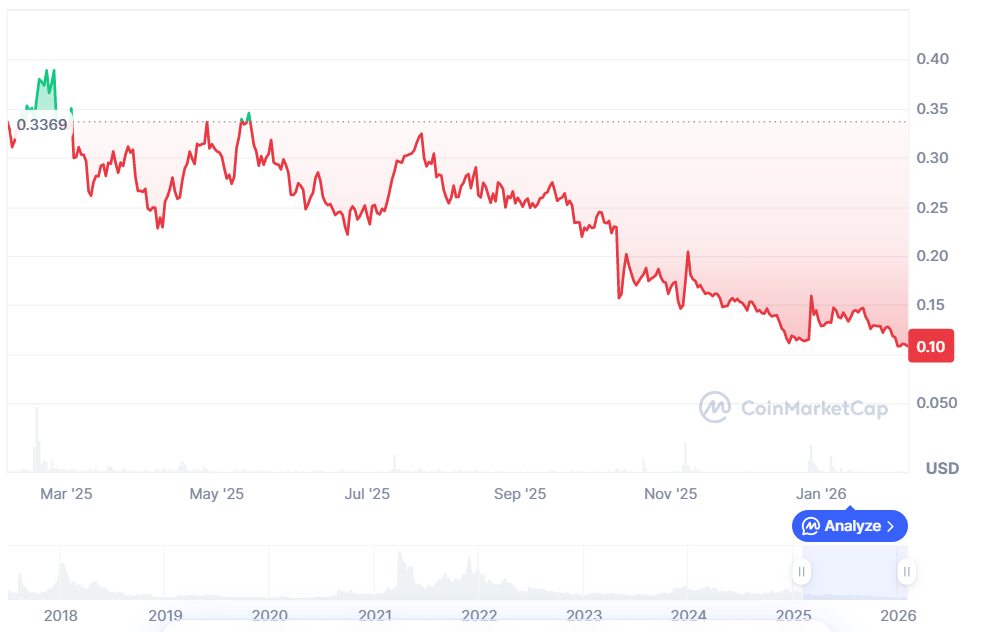
Looking at the 1 year chart, it will soon be at 1 cent anyway.
But no, why whould it become worthless over night when Storj pays their SNOs with a stablecoin?
It is literally mentioned in the whitepaper:
Although the Storj network is payment agnostic and the protocol does not require a
specific payment type, the network assumes the Ethereum-based STORJ token as the default mechanism for payment. While we intend for the STORJ token to be the primary form of payment, in the future other alternate payment types could be implemented, including Bitcoin, Ether, credit or debit card, ACH transfer, or even physical transfer of live goats.
So it is simply time to implementing these other payment mechanism - maybe not payment by live goats - so SNOs do not bear the risk of getting paid unfairly.
The solutions for this do already exist and have been mentioned many many times.
Of course it is running in circles because the payout system has a fundamental systemic flaw. Unless the root cause is not solved or at least mitigated (e.g. by some kind of auto-conversion at the moment the funds arrive) the discussion will keep coming up.
So at least for now I even have to be happy that I was finally able to sell yesterday. Even at a terrible rate. But less terrible than it would be today.
How can any sane person wholeheartedly say this system is working great?
SNOs get effectively robbed from their pockets for what you have already provided.
And hopefully Storj did not purchase many Storj coins last month. They are getting worthless day by day.
Look, storj aims to pay $130k/months to nodes (figure from this forum). 5% of that is $6.5k that goes into pockets of gamblers and other “market participants”. That value leaves ecosystem every month. How is that not a problem?
So ys, it’s a big problem.
You did not look hard enough. Volatile settlement instrument is an oxymoron. And I’m being very restrained right now in my choice of words.
If storj wants to continue playing token games for value extraction from the “greater fools” to further the company interest – fine, none of my business. But I prefer to be paid with something that does not compost on the way to my pocket.
It’s been like this since the beginning. 100% of your payout is from those same speculators/gamblers. Why should it be different? STORJ is their free money printer.
I’m very open to posts where people complain about receiving extra fiat from upwards short term volatility after payout.
This describes the mechanism, not how things should work. Early speculative capital helped bootstrap the network; that is not a steady-state model. In a steady state, operator payouts cannot depend on speculative markets. When I earn $100, I expect to receive $100 — not maybe $90, or $110 or some other number. If I want gamble market exposure, I can choose it myself and buy this or other token, or a lottery ticket. It should not be bundled into the storage transaction, yet today it is. That’s why.
Receiving a different amount than implied because of volatility is not “extra”. When settlement depends on timing and luck, the operator carries risk that was never part of the deal. Infrastructure requires predictable pay. Operators provide storage capacity, not market liquidity. This is a storage platform first and foremost.
At system scale, payout volatility acts as a filter: operators who need predictable economics stop scaling or leave, and those comfortable with uncertainty take their place. Over time the supply mix becomes less predictable — not a direction enterprise platforms typically want to move in.
No, I don’t think so. Let me suggest something: If 5% of the earning amount is not much for you, why don’t you send that share of your earnings to me? Deal?
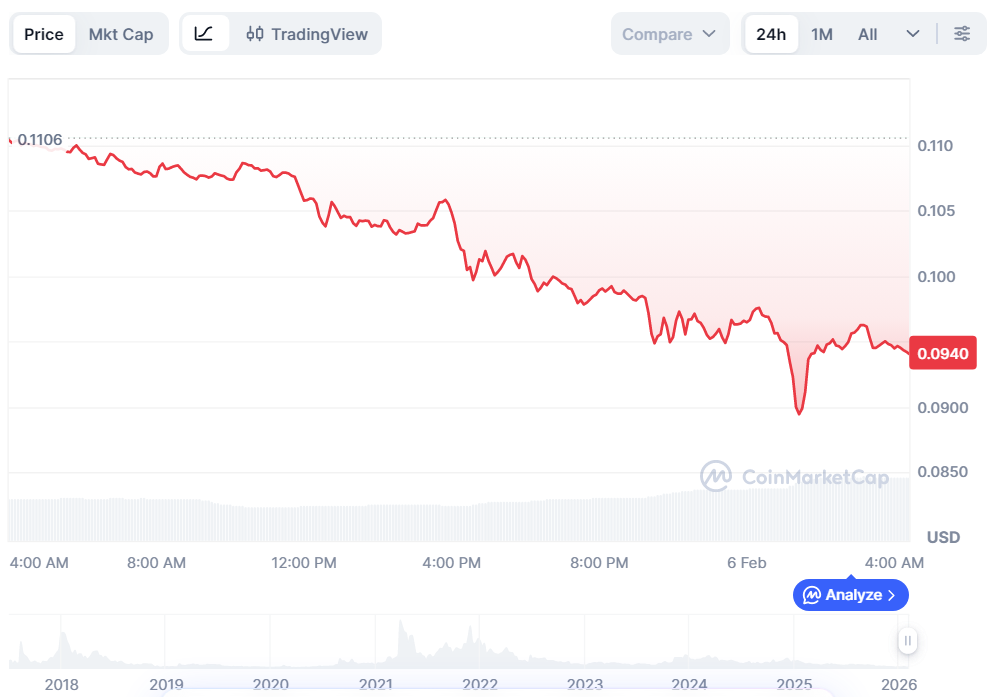
The reality is that the volatility of cryptocurrencies that are not stablecoins is not limited to 5%. STORJ went further down after I had sold. I would be down by 10% today according to the prices I see right now. And I can compare that to the rate that I am seeing from Wise, like when Storj would transfer USD to a USD bank account. It is the same rate like yesterday. No change at all. And I am not saying the USD value cannot change too, in fact it has recently, but it is still much more stable.
And that’s just one of many points. STORJ conversion happens already always at a worse rate worse compared to receiving USD directly. And now we see the yesterdays drop on top of that. All of that with money that should be in my pocket now, not in somebody elses pockets. With that drop, I am roughly down to the previous months payout which means all gains from the last month have evaporated. Such volatility (and I am talking gains and losses here) is not a good feature for a token that is meant for settlement purposes. And frankly it is absurd to expect SNOs to get up in the middle of the night having to sell their freshly arrived tokens in a rush to avoid potential losses.
I don’t see why not one way or the other. I prefer the one that lets the company mint free money. When the treasury runs out I’m open to changing views.
One can argue you did indeed receive $100 worth of STORJ.
I am not sure how to interpret operators actively participating in the network and receiving payment as anything else but actively choosing to accept how payout is handled. I agree with you they are free to leave if they disagree. The change in how much SNOs will be paid will be more important than how.
Anyways my earlier point is that if people are complaining about volatility, they should also complain when they benefit from such volatility, but we don’t ever see that.
Volatility in settlement is always bad as it is a risk for at least one party. It is not about being lucky to gain or unlucky to lose. This is not how it should be.
And this is about to change. Storj will have to buy the tokens they need for payout from the market.
That’s when volatility will hit them as well.
And I am even wondering if once they are forced to buy STORJ to be able to pay their SNOs if something like the Gamestop short sqeeze could happen? Maybe.
This is exactly what I am talking about.
Given the 12 month chart of the STORJ token, maybe there haven’t been too many who benefitted in such a way. I don’t know.
People talking about stablecoins in here are probably living on another planet, or on some happy little island with no legislation and total political/economic anarchy. Stablecoins make the whole system legally completely different. Please… nobody is ever going to use a stablecoin to pay thousands of under-the-table workers around the world. The only way is to stay in the shady world of little tokens
If they become profitable enough, I could see it happening one day. And at a certain threshold they force you to KYC: $600-annual I think? You need to stay small to avoid the IRS