I have been away from the world of Storj for past 5-6 years.
I used to run about 4 nodes (on different hosts/IPs/Ports) from a single location, but after a year or two, ended up loosing 3 nodes due to x,y,z reason on my side.
That aside, I completely forgot that I had 1 off these nodes still running (fully vetted by 2020), and it was allocated 10TB off space capacity from my local storage pool (ceph) (across 13 physical hosts with redundant networking/LACP + Backup Power etc). The setup runs a LXC running the storj docker image against a Ceph FS mountpoint, so even if certain physical hosts go down, the LXC can come back up and data should be available as long as Ceph is healthy from my end.
I have been hands off on the whole setup for years now. Long story short, I checked up on the host after many months, and it seems it has used up nearly all of its 10TB of capacity. I guess I must have missing out on potential earnings if the demand for Storj has been rising over past the few years?
Today, I briefly stopped the node, and increased the storage from 10TB→50TB for this single Storj node, and the dashboard registered the extra free space etc.
Question to the community:
Is it likely it will fill up over time, and if so around what rate do folks expect this 10TB to go closer to 50TB or wherever it may settle?
Whats the average storage (GB or TBs) provided per node for Storj these days?
I am happy to start reading up again on the forums here, its been far too long. Cheers!
I think it is close to never, as more data you have more deletes it get. But ingress depends on clients. If only there will be miracle and data will start to go like from fountain all the time.
Thanks, I can see that if there is constant rebalancing off data across all nodes and if # of nodes rise proportionally to storage demand, then it can remain at 10TB, but I was curious if the average node operator is close to the 10TB mark or well below or above it these days.
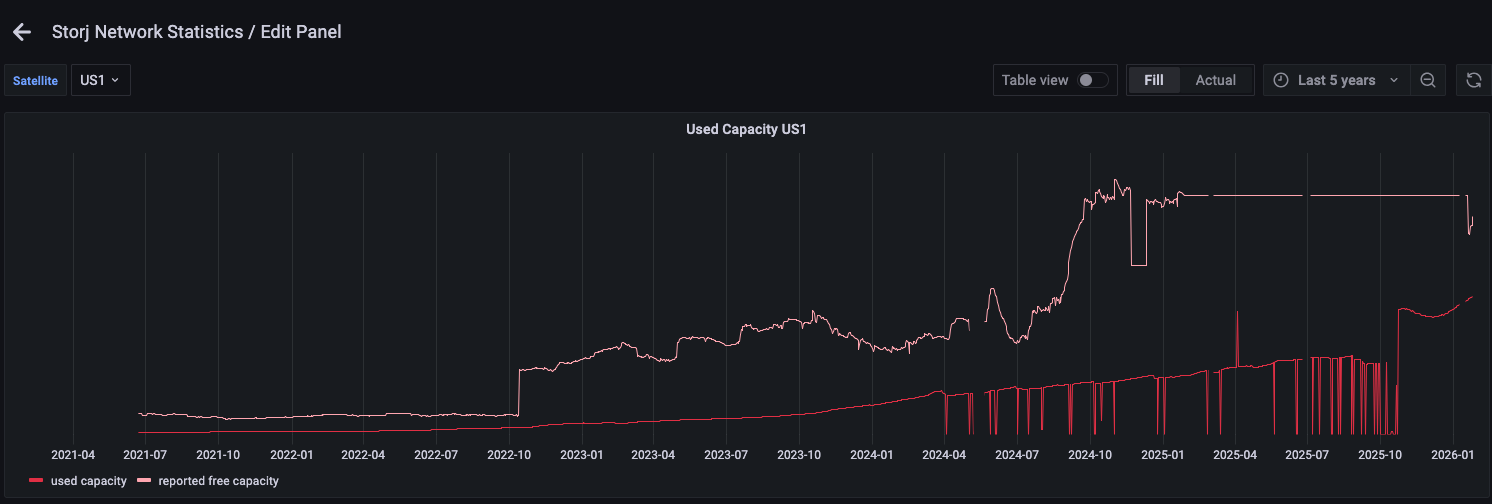
The charts on storjstats.info are they up to date?
Curious, why the reported free capacity is flat lined for months, and used is slowly growing.
Did Storj stop accepting new SNOs or only accepting on selective basis?
Oh man, I feel so out of the loop on Storj news, and I just read the team got bought out, .
The used-space number on storjstats.info was broken for almost a year, and just fixed around a week ago. Active node count continues to rise: looks like around 6000 in the last year.
Most nodes aren’t 10TB so I don’t know what their growth rate is: but an average of around 10GB/day is probably a reasonable guess. I think being able to fill 8-10TB in a 2-3 years is fairly common.
Max 20TB, not 50TB, that’s too big for the node. My node on a IP/24 at one location, 26 months old, now has 10TB full, just as a comparison. Every 2 days, 80-100 GB are deleted. So it fills up very slowly.
Thank you both for the quick reply. I just readjusted the storage to 20TB from 50TB, .
Looks like I may want to start the whole process again for a few more Storj Nodes on different IP/Ports just because it takes a long time to get fully vested.
I heard the KYC is if the storj operator earns > $600 if in the US, is this still true? Does it apply to US individuals only, or can one register it under an entity as well (the email / reward address?) with Storj?
Obviously, I have been earning way less than this per year, so I haven’t filled out any other forms to Storj etc, but simply declared it as mining income on tax returns etc.
Yes, if Storj pays you more than $600/year you need to KYC with them. That applies to everyone (though if there are any tax obligations: that’s still between you and your local country).
Another question, since I have been out of the loop, hmm.
Setting up different ports on same public Wan IP won’t work for different Storj nodes, right? Is that still the case? It truly needs a different WAN IP per node?
I was wondering if I try different ports with different storj nodes on the backend with same public WAN IP (dynamic not static), I am not sure if the system/network will favor those nodes for data storage… even worse, I figure it may split the data between N nodes off mine because its all coming from same public dynamic WAN IP?
Whats the latest recommendation here? I do have a bunch off static IPs but I haven’t gotten around to setting them up yet, but each one can be used per storj node if that’s the only practical way forward?
You can put as many nodes as you want as different ports on one IP… however Storj Satellites treat all nodes in the same subnet/24 as one - for the purposes of directing customer uploads. Which means 2 nodes on one IP don’t grow 2x as fast: they share.
Yes, that means if other people in your neighbourhood also run nodes (because of how your ISP allocates IPs)… you may be sharing with them. You can check if you have any “Storj Neighbors” here: Neighbors
The best way to grow faster… is to have nodes on different /24 IPs. As long as they’re on different subnets you’re fine.
For me, the oldest nodes (5 years) flattened at 16TB for almost 2 years. Other ones (3 years) flattened at 10TB. And I am one of the lucky ones who get pretty nice ingress. Others reported even 5x less ingress than me. The thing is that who usese Storj as backups dosen’t keep backups older than 2 years, so what you manage to store in 2 years as a SNO, that will be your limit. After that, the node grows painfuly slow because the deletes equal the ingress.
Well, I’m not a good model to follow, because I only use brand new hardware and, with only one exception, all rigs are just for Storj. And all drives, except 2, were new. After 5 years, still didn’t recover the investment. But I don’t regret the choices. I only regret that I didn’t set all of them sooner.
And I won’t say unattended… I kept changing and impruving settings, testing and retesting things.
But yeah, they are working pretty much flowlessly, with a few hiccups.
As I promised, here are my stats. Node 1 (5 years old): 16.59TB after 5 years.
Maximum space occupied reached: 18.8TB, after 3.5 years.
Intake per year:
-year 1: 2.62TB/year
-year 2: 5.41TB/year
-year 3: 5.43TB/year
-year 4: 4.12TB/year
-year 5: -0.99TB/year
I think you’re getting lucky with ingress: is your second node in the US? Not many people post their results: but it sounds like a lot of SNOs only get 3-4TB in their first year. Congrats!
In EU, but a lot of EU nodes also have 1-2TB per year. So, I don’t know, maybe there are fewer in my region. I don’t use VPS, so this must also count.
The intake degrades a lot after the first year of a node, even after the first 6 months. I don’t know if this year it will pass 12TB.
My largest node is ~5TB, but largest subnet is a remote office I oversee with a 2.5TB node … and 24x ~600GB nodes, which comes out to 17TB for the subnet. I’m not currently experiencing any slowdown for the subnet, but don’t expect it to go over 20TB
 .
.
 .
.