How to buy Storj tokens on the exchange

PSA: For the benefit of any other crypto-newbie “small” users like myself discovering this thread and considering the STORJ tokens to avoid the $50 minimum charge, stay far away from “binance dot us”. I was considering them because web searches indicate their fees are the lowest for acquiring and transferring the tokens. They are rude, slow, and utterly draconian and buried in broken bureaucracy and technology with their AML/KYC processes in a way I have experienced with no other financial institutions.

By contrast, Kraken’s KYC process was automatic and virtually instant.

Feel free to DM me for details, or I can post here if requested.

Please share your experience, I was gonna ask you aware of binance dot com - but I ask gemini instead:

Can US citizens use binance dot com?

No, U.S. citizens and residents cannot officially use Binance.com. Due to strict U.S. financial regulations and Know Your Customer (KYC) laws, the global platform prohibits users from the United States.

(Forum Moderators – please don’t beat me up for the length or being relatively off-topic for Storj with this. I would have sent a DM instead but I’m too new to the forums have access to that feature, I guess. If you feel the need to edit or remove this, I totally understand.)

Correct, “binance dot us” is the “sister exchange” to “binance dot com,” though they are completely different companies. Maybe they are better – I can only speak to my experience with “binance dot us” (I live in California.)

I have a US PO Box because I live in a rural part of my county where the US Postal Service does not physically deliver mail. It’s tied to many of my records that financial institutions see. As I’m sure is common knowledge, AML/KYC regulations, especially those in California which I believe are some of the most stringent, require proof of a physical address. I am quite used to having to do this – and was prepared to have to do so again.

For an example of how this should work, Kraken’s automated system asked for my name, US social security number (SSN), phone number, and physical address, a photo ID scan (which has my PO Box on it btw and not my physical address) and a selfie for comparison. I provided them NOTHING with my physical address on it other than the statement on their signup form. Their backend system was immediately able to pull records and see that everything matched what I said, and I was done. Took all of 5 minutes (only issue was turning off some of my privacy protections in my browser to let the camera work for their ID scanner and selfie), and I was fully verified.

I have had similar straightforward and easy experiences with EVERY other financial institution with which I’ve ever dealt over decades (with the only exception of adding a trust to the ownership of an account… talk about 4 football fields off-topic, don’t get me started on that…:wink: )

“binance dot us” on the other hand only does “Basic Verification” first – where they asked for all the same data as Kraken except for the scan of the ID and the selfie (that comes later in the “Advanced Verification” if one wants to add a bank account). I provided nothing that said I had a PO Box in my mailing address. Their system still detected somehow that I had one and directed me to customer service chat (no live telephone support). Their chat agents were slow to respond – first bad sign. Then when I finally did connect, they asked for a utility bill showing my physical address. Fine, I have had to do that before, no problem - I gave them TWO. But here’s where it got insane. I masked out the financial data on the bills (like the dollar amounts and the account numbers) and was completely forthright that I had done so. That is data that is utterly irrelevant to their need to verify my address and an unnecessary (even further) invasion of privacy. They refused to accept modified copies. I then provided them with an unmodified “Payment Reference Letter” from one utility, which they also refused to accept. I finally tried to give them two more documents, my home insurance declarations page and my property tax statements (the latter is public record anyway) (which their own web site said they would accept), but they refused those too saying they only accept those when their system doesn’t flag a PO Box AT ALL.

When I protested that this was truly comically absurd and that they must have many customers with PO Boxes, they said (paraphrasing only slightly) that, yes, many did – but those customers were cooperative and done in 5 minutes. They also insinuated that I was trying to commit fraud, which is laughable given that I told them up front what I had masked and why. I said if others wanted to sacrifice their privacy unnecessarily, that was their choice – but that I wasn’t going to.

A later consult with Google Gemini affirmed my suspicions – they are using backend OCR systems that are choking on any PDF modifications and unable to recognize the valid structure (logo/font/layout/etc) of the rest of the bill that contains the info they need. Kraken and others have a more robust system that matches the information provided against other known public records.

Given this kind of treatment, it became obvious what their customer service would be like for anything else. So to end this long saga, I filed a CCPA (California Consumer Privacy Act) deletion demand with them to throw away all my data they had collected so far, and filed complaints against them with California oversight agencies.

Just insane. My biggest stupidity was continuing to try with multiple agents and supervisors. I should have immediately shown them the door.

TL;DR for Storj folks, if you want to promote the use of STORJ tokens, an FAQ or KB article on the easiest (without high overhead) way to acquire them for your customers in different regions who know nada about crypto would be great.

Hey there, you masked it with physical duck tape or digitally edit it? I think digitally might trigger some response, just guessing.

P/s: wait, so the bill was digital in the first place? If so I get it now :smiley:

The files were downloaded from the providers as PDFs and edited. This has been acceptable to every other financial institution I’ve ever dealt with, and government agencies too.

But you are almost certainly correct that an edited PDF was causing their backend OCR PDF pattern matcher / whatever to barf. Forget the fact that their tech is inferior to other institutions, but the fact that they wouldn’t override given the overwhelming amount of evidence provided (or even accept UNMODIFIED documents on their own list simply because I had a PO Box at all) just proved them to be ridiculous.

P.S. I reserve my duck tape for actual ducks (geese in a pinch). :wink:

I’ve also worked with some companies with the same policy: they’re looking for an accurate digital copy of a document. If there are any obvious signs of tampering they just reject it.

That’s fair: if you don’t want to send them something unedited - there are other CEXs/DEXs to work with.

Yes, and at least one other exchange (Kraken), sailed me on through without even needing a physical bill uploaded - because they have better tech able to access all my public records and see the physical address matched (a little scary but at least more convenient).

Any system looking at these PDFs should be able to tell when the data they care about (name/physical address) is proper (right font, right logo, right layout) and unmodified, regardless of what is masked on the rest, especially when such masking is openly disclosed. And given that many other financial institutions have accepted these same documents in the past (including major banks and brokerages) – “binance dot us” is clearly being over-zealous at the very least.

But I’ll point out again that I DID offer them an unmodified document (property taxes) on their own list – which they also refused to accept simply for the fact that I also had a PO Box associated with my name at all. This last one truly defied all logic and is what sealed the deal for me that trying to use them for anything would just be one hassle after another.

It is frustrating to live in a world where the bad actors make it miserable for the rest of us (AML/KYC, the US Patriot Act, and other invasions of privacy) – and those same bad actors have probably just found a different way to keep doing what they’re doing anyway. :frowning:

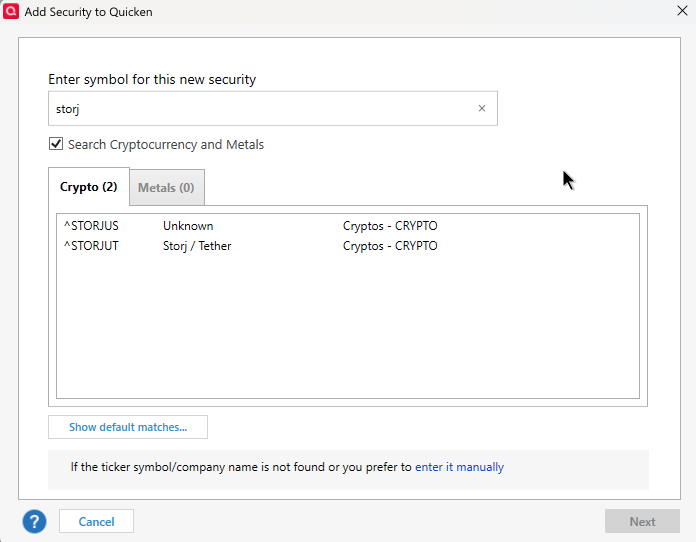
Any Quicken users out there? I want to track these STORJ tokens like I would a stock, and Quicken comes up with two possible ticker symbols, ^STORJUS and ^STORJUT. The former says, “Unknown” and the latter says, “Storj / Tether.” I was thinking since I’m in California, I should pick ^STORJUS, but I’m unsure. Thoughts, anyone?

Oh, I see – “Tether” is a crypto “stablecoin” currency. Told ya I was a newbie to this. Looks like I want ^STORJUS then.

I did the same with another exchange. I live in the EU and some Exchanges understand MiCA as a reason to request my entire tax declaration including the salary of my wife and much more private information. I uploaded my token report instead that clearly outlines this history of my tokens. It explained them once that the only way I can give them my full tax report is if the communication is handed over to a devision that understands the local laws and understands the additional security requirements handling these kind of documents. I am legally not able to upload secure documents to a website that is missing a basic privacy information. I don’t know where these documents will be stored. I don’t know who is going to read them. I don’t know how long they will be stored. Sorry that is not in line with local laws. I will not help them to violate basic GDPR rules.

I explained what kind of documents I can provide and if that is not enough than so be it lets terminate our contract. They can either get more trading fees for me or let me switch to some other exchange. What they can’t do is force me to violate my own rights according to GDPR.

Well, that was agony. Even with Kraken, I had to jump through hoops to get money in there with a wire transfer so that I could buy and withdraw STORJ the same day as the funds landed. Had to do two orders (a tiny one for 50 STORJ tokens just to make sure it all went well, and then the actual one). At the end of the day finally ended up with 9% more value in credit with storj.io than I did withdrew from my bank - so that’s nice. I put enough in there to hopefully last me the better part of a year – because I definitely don’t want to do this very often. Figuring out how to track it all reasonably accurately in Quicken was also “fun.”

Oh get this – now today “binance dot us” came back, and said, “Oh, you’re verified now, congratulations.” :roll_eyes:

I said, “Nope, too little, too late. Delete my data with no retention per CCPA, since I asked you to do so before this verification, and confirm. I won’t trust you with my money after this.”

Wouldn´t be better if STROJ run some kind of FIAT–> CRYPTO (Storj token) gateway? So customer can still use FIAT to pay for services but on the backend STORJ tokens would be bought from exchanges. Token price increase incentive will work and customers do not need to go buy STORJ tokens on exchanges.

There are already many places to buy STORJ, and as soon as the company starts dealing with fiat token sales they also have to deal with fraud like chargebacks. Let the CEXs/DEXs deal with fiat->crypto gateways: it’s their business to be good at it.