Did you try to enable the native Windows cache writes on the drive?
Sorry, I missed the reply initially - but yes I checked and all my drives have it enabled:
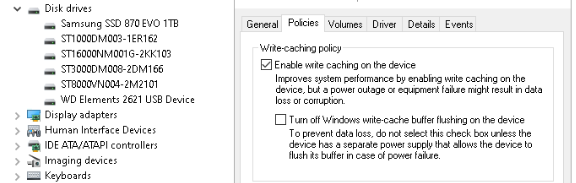
And if you enable the second one checkbox, would it has the same effect as a Primocache (without SSD of course)?
My nodes doesn’t have this issue, so I cannot check how effective is it.
That seems like a pointless risk if I’m not missing something. If I disable this, it means Windows will hold more stuff in memory. I don’t want that - I want it to write to the disk, but not in individual files since that seems to overload my disks. Instead I want it to kinda collect small blocks of data and then flush it - which is what primocache is accomplishing
problem with primocache is that it storing MFT of ssd in RAM, if you have power loss, you will lose files that was buffered.
1 Like
You already took that risk when you started to use a Primocache. So not a big difference.
If you enable both checkbox, I believe that the system would start behave as with Primocache: it would keep stuff in memory while it’s accessed. It would eventually be flushed to the disk anyway, especially if it would require more RAM to execute other processes.
I tried to find online how long it waits before flushing but couldn’t find it? I know with primo I have it set to flush after 1 second, which is a risk I’m willing to take, but do you know what the windows time out is?
Okay awesome, that sounds like it will roughly do what primo does. I’ll try it after the current filewalkers are done since both my big nodes are frozen (allocated less space than they have) to prevent ingress
Yes, this is why I asked you to test, because I will not see a difference on my setup anyway (it doesn’t have issues).
However, the Primocache also offer a tiered Storage with SSD, but it’s also possible to configure with a Windows Storage Spaces and a PowerShell (for honestly sometimes I think that they built a GUI above already existing options in the Windows kernel, which do not have a nice GUI yet or requires to configure something in several places…).
I forgot to respond here and responded to you in a different thread - but after I moved the DB’s to the OS SSD, the ram usage now hovers 500-1000mb without primocache. So essentially what PrimoCache was doing for me is bundling those small DB writes/reads into larger chunks. Removing those everything seems to run fine without needing to disable the buffer flushing and what not!
1 Like
Would you like to mark this post as a new solution?