Especially in different locations.
We still need nodes there:
If you’re here to get rich, you are here for the wrong reasons.
Maintaining a handfull of nodes successfully for a few years will net you a decent side hustle - it’s never going to be a full time job.
It does not sound like you have a full 1TB stored. You’re not payed for the amount of space you provide, you’re paid only for the amount of space used. Additionally, If you’re storing 0GB on day 1 and 1024GB on day 30, you will get the average for the entire month, 500GB paid out on day 30.
The full payout scheme is available here: Payout - Storj Docs
If your node is entirely new, you’ll also need to wait for the node to become of age, before your income raises to 100% /month.
The full explanation to the held back scheme is available here: How does held back amount work? - Storj Docs
I hope this clears things up for you friend 
What I mean by node age is described in the “how does held back amount work” article, with the excerpt:
- Months 1-3: 75% of Storage Node revenue is withheld, 25% is paid to the Storage Node Operator
- Months 4-6: 50% of Storage Node revenue is withheld, 50% is paid to the Storage Node Operator
- Months 7-9: 25% of Storage Node revenue is withheld, 75% is paid to the Storage Node Operator
- Months 10-15: 100% of Storage Node revenue is paid to the storage node operator
- Month 16: 50% of total withholdings are returned to Storage Node Operator, with the remaining 50% held until the node gracefully exits the network
Long story short, first when the node is 10 months old, you’ll be paid 100% of what you earn
just for fun and learning i would like to setup a community satellite, but i have looked almost everywhere for a setup guide, but no luck
@jtolio are there such a guide or any info on how to set it up?
EDIT: what i’m after is to kind of setup a “ghost/mirror” storj setup so i can better learn and understand how it works and maybe in the end discover if there are any parts i can help with other than being a “simple” node
If you are in the position to recommend (huge PB) customers to Storj, that would help.

 sorry, no rich friends on store
I would start with https://www.youtube.com/watch?v=gIMkpL8pB74&list=PLdOvfSMuclJprNPPuVF_ZS7y7xsjsqK0-
And:
But some code reading skill may also be required, unfortunately.
the code reading skills yes, but the docker compose should make it more easy
for the live storage node i run it was easy in portainer, just paste in a stack file and ask it to deploy, it has run stable ever since except for 1 min of downtime due to an update

so this assumes that go is installed allready? are there more than needs to be installed? or is go inside the docker image?
figured it, go needs to be installed first
the first roadblock
root@bo-omv:~/storj# storj-up init db,core,admin,edge,minimal
-bash: storj-up: kommando ikke fundet
command not found… do i need to add something before ?
go is installed
root@bo-omv:~/storj# go version
go version go1.25.4 linux/amd64
EDIT:
i followed the instructions here to install go: Download and install - The Go Programming Language
and the install command placed the bin file here: /root/go/bin/ so the correct command ended up being: /root/go/bin/storj-up init db,core,admin,edge,minimal
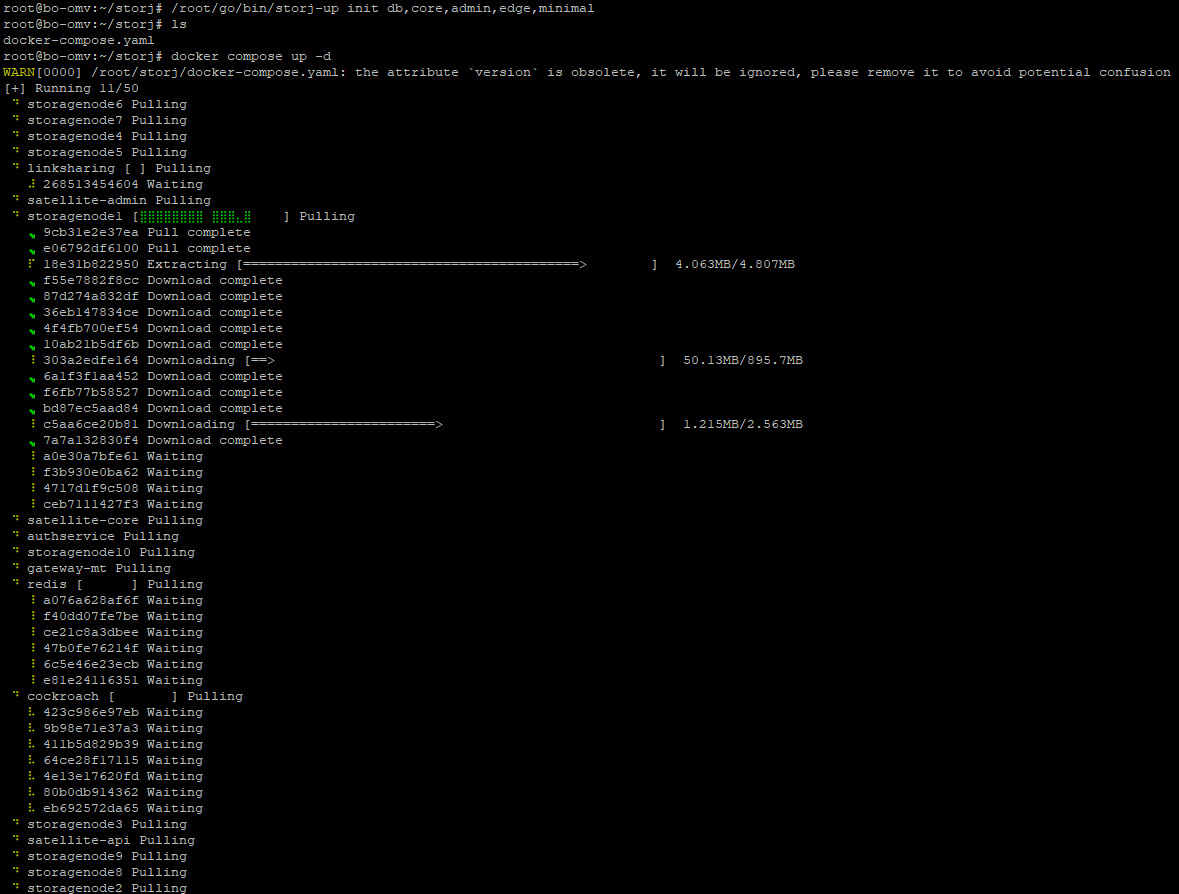
EDIT:
that was not to painfull, i guess to get as close to how storj has it setup i need move down to “more features” and run storj-up init minimal,satellite-core,satellite-admin,edge,db,billing
and that tweaking is done in the docker-compose.yaml file? or are there a web gui that can be used for that? just so i can poke my nose arround
EDIT2: with tweaking i mean things like what satelittes that the user can create accounts on
i quickly found the login at http://192.168.0.163:10000/ but the list of satelittes i would like to only be my own and not the official ones, so where do i config what is availble?
EDIT3: also where is pricing set? and what payment options that the user has?
The configuration and the docker-compose file are tweaked by the storj-up binary and subcommands, you can call it to get help about commands and subcommands.
Usually changing parameters are done by storj-up env setenv command, e.g.:
storj-up env setenv satellite-api STORJ_CONSOLE_GATEWAY_CREDENTIALS_REQUEST_URL=http://ipaddr:8888
storj-up env setenv satellite-api STORJ_CONSOLE_LINKSHARING_URL=http://ipaddr:9090
storj-up env setenv authservice STORJ_ENDPOINT=http://ipaddr:9999
storj-up env setenv linksharing STORJ_PUBLIC_URL=http://ipaddr:9090
See readme on GitHub - storj/up: Docker-compose files for running full Storj network locally
However, you also need to examine the code to figure out, which environment variables you can use to configure something.
The rule for environment variables is the same: STORJ_ prefix, then any option in an upper case, all dashes and dots should be replaced with the underscore.
For example, the pricing for customers can be set with these variables:
For nodes:
However, your satellite will not join the Storj production network. Each satellite has an own database, they do not exchange with a metainformation. So, your satellite will not have customers of the production satellite, even if your satellite would be added to the white list. It can share the same nodes, but not customers.
i know and others have told it many times, its like people think i want to do that
all i want was to study how storj works “under the hood”.. ie complex and how hard it is (of course that has to be compared against my knowledge and my ability to learn new stuff)
I’m thinking about how it could be implemented to exchange the metadata between different satellite clusters to allow customers to connect to any satellite and get their metadata and data. Perhaps this might be implemented if we decide to merge these three production satellites.
i’m looking at the very first post…. just staring at it with an almost idle “brain”
phase 1, it sounded like a good way to start, but yes, there is the trust issue again
but also there is the config of such a satelitte, the list of options are VERY long and how do the operator know if its done correct? at least for me it very overwhelming, an “copy from master/storj” option would be nice, a web gui even better
the storj-up “package” was reasonble easy to get going, but then there is the config of it, i admit defeat on that part.. i can run it, i can make sure it stays running, i have lot of time to monitor it, but man the config part… i assume its almost just a one time config but still
and then how much of what comes in storj-up is needed in the end?
A little more - also storjscan and a configured billing, also an integration with a payments processor to accept cards and many other payment options.
Then you would likely think to make it distributed, so auditors and repairers likely would be deployed separately from the remained satellite’s services.
But if the trust issue could be overcome and the satellite where to be run like said in first post it must also be so simple to setup as a storagenode
New external satellites are set up extremely rarely: I’ve read about people doing so a handful of times since Storj launched: on average maybe once per year: so there’s not much benefit from automating the setup more. But I guess if a community member wanted to beef-up the install doc Storj would probably accept their commits.
It’s not because it’s hard to configure: it’s because you need 100+ SNOs attached before it even works properly… and you need way more to make it reliable. Unless you’re a small company running it internally or something… not many people try open-source projects that require 100+ friends too 
I don’t think so. You only need some nodes. The setup script creates 10 test nodes and this can easily be changed to any number you want.
also read the first post again, they way they word it
to me its sounds like satelittes just like the 4 there are now, but run by the community
its a great idea if it was ever needed, but yes 2 issues, they dont trust us enough (yet) and the setup is at least to complicated for me to understand - way to many options and no guide on how to set them, just have a look here:
and i would as a community satellite not expect to do other than start up the satellite and keep it running, i should not deal with billing etc, that is for storj to handle or else it would drift away from the wording of the first post fast