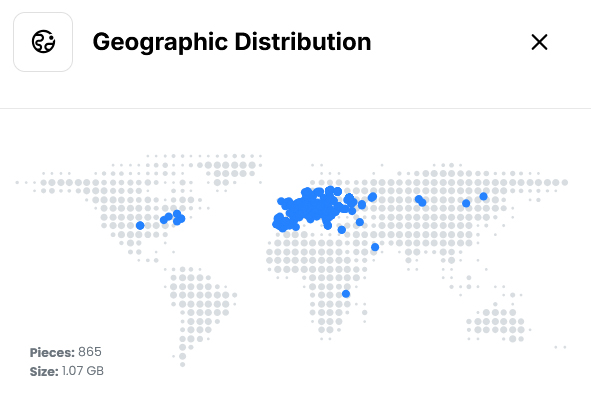
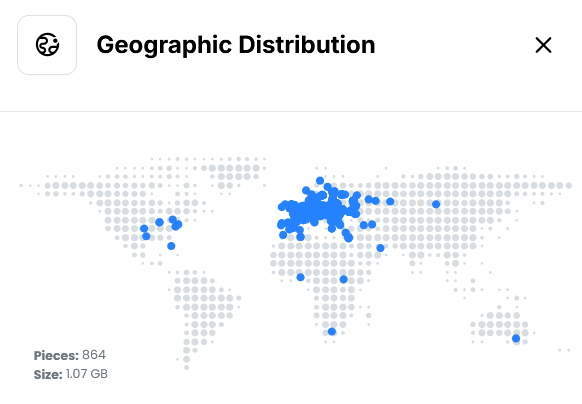
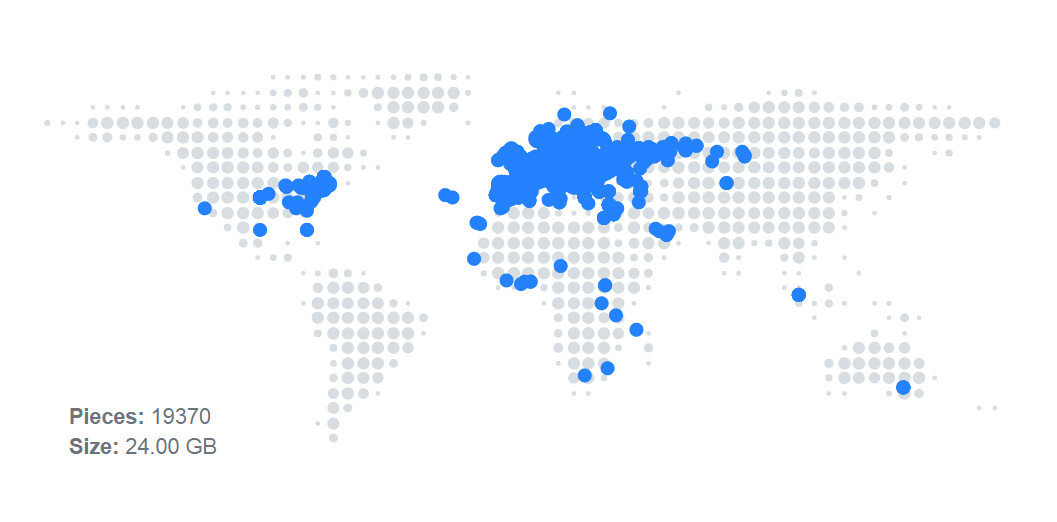
This is what I get when uploading the same 1 gb file to archive or global bucket:
Archive
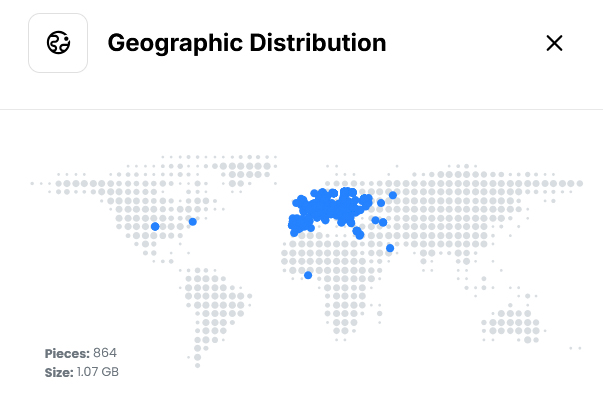
Global
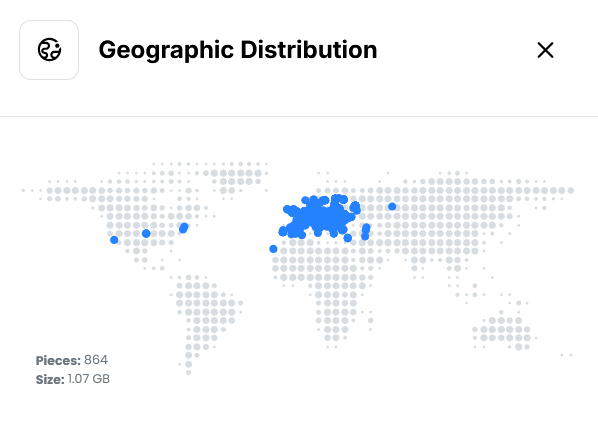
This is not the expected result tbh. What am I missing?
What is the expected result?
Shouldn’t Global have more pieces and some kind of global distribution? 
Storj does not publish details. So I assume it’s snake oil and difference is in pricing only, at least for now. There is no reason to store hot vs archive data any differently.
That extra dot in the U.S. west coast looks like my node lol 
I must admit I do not see a fair global distribution either.
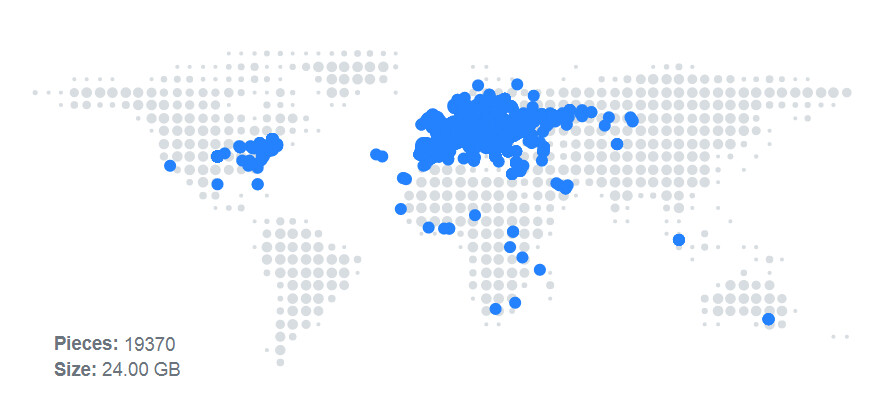
However that was already the case in the past:
The test files in question have been long deleted. However what I recall is with huge files like 100 GBs or something, the map will have more diverse location display.
The reason?
It may be
but this would not make sense in the long run and fraud if you simply pay more for the same.
However what we keep forgetting is:
And finally the new node selection:
it would not surprise me if satellite keeps sending data to the same fast uploade nodes that the data would end on the very same fast nodes with a limited geographical variety. For a geographically diverse and fair data distribution the upload speed cannot be key.
No, you are paying for advertised features and receive what’s promised. How this is accomplished on the backend is not relevant. Maybe today its same, tomorrow some parameters may change, this would be implementation details.
For example, for archival storage the piece distribution may be exactly the same but upload priority and performance guarantees may differ. For host storage performance may be prioritized. Etc.
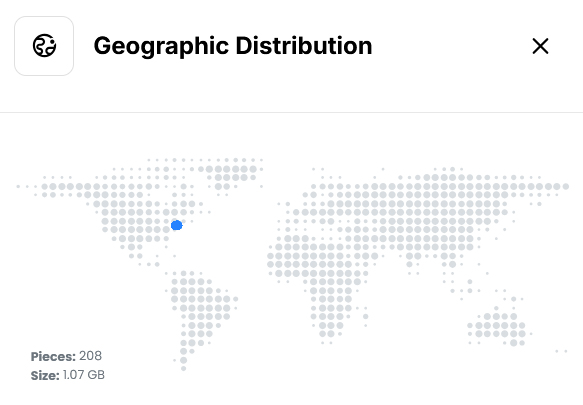
If that’s the case, then yes. Based on the picture, who knows. OP would have to do some performance tests. Then we would see.
Global Collaboration: $15/TB + 1x egress included, $0.02/GB extra egress, no minimum retention period, minimum object size is 50KB
Active Archive: $6/TB, no free egress, all egress $0.02/GB, minimum retention period of 30 days, minimum object size is 100KB.
Why do you call it fraud? Prices and conditions are different, the distribution is the same. As far as I understand, repairs would distribute pieces more evenly during the time.
Because
is what the definition implies:
Paying more for the same product that is advertised as different is fraud for me. But as I said, it does not make sense, as it would not payoff in the long run for the company. So there may be some not so obvious features like
that will result in a more even distribution and better performance everywhere.
From a customer perspective it would be very interesting to know how long this process will take after upload if your work requires this feature and you rely on it.
But it happens all over the place everywhere else. Same cars are sold under different brands at drastically different prices. White label manufacturers of variety of grocery items producing the same product for a zoo of brands who sell them with a wildly different marketing stories and markups.
In other words, same product under different positioning is normal market segmentation.
Fraud would require a specific false claim: different ingredients, different service level, different durability, different performance, different support terms, etc. If the seller only wraps the same thing in a different story and finds someone willing to pay more for that story, that is mostly marketing, not fraud.
It becomes fraud when the advertised difference is factual and false.
This is not the case with storj. They specify pricing plan and performance and deliver on it. In fact, the pricing plan alone can be tailored to be attractive for users seeking a match for a specific workflow without changing anything at all on the backend. Very valid. Not even remotely fraud.
This is the key. You must deliver what you advertise.
Right. But it does not mean you have to deliver different things.
One user wants sweet fruit. One user wants round fruit. One user wants crunchy fruit. One user wants raw material to make apple pie. STOrJ sells apples of the same variety to all of them. Single product. Delivered on every promise.
“Access to global network” satisfies both workflows without changes today, both archival and hot storage, without changing a thing. Of course anything can be tuned later but this would be implementation details and irrelevant ones.
I think the key difference between these two plans not the pieces distribution, but will you pay for egress and a minimum retention fee or not.
The Global Collaboration is used mostly by globally distributed teams, they also need to work on the prepared media file, so they will download it in their place, partially or the whole. And when you edit a file you will read and write it almost randomly, with the Active Archive it would also mean, that even if you overwrite the file, it will be still accounted for the next 30 days, also every GB of egress will be paid, so it may significantly affect the billing. So for these use cases the Global Collaboration will be much better.
It means you have to deliver some thing that has the advertised/promised features and that were agreed/relied on.
Yes I thought of a use case like a film shooting at some place in the world with large amounts of data uploaded and a download at another place later.
Exactly. But if they use Object Mount, they even do not need to download it, they may work on it directly from their tools. But since tools will act like they work with the local system, they likely will partially download edited part of the file and then overwrite the whole file or part of it after editing. So, they may download the file entirely and write it back to the bucket after the edit is finished, depending on the tool, of course. Some may download and overwrite only part of the file.
Did you download the file from the US and uploaded it back from the US, as supposed to be used for a globally distributed team?
I don’t think that repair is aggressive, I believe it’s triggered only when the amount of healthy pieces is fall below the repair threshold. I also not sure that you and me correctly interpreted Global Collaboration as the change in the pieces distribution. Perhaps it’s only 1x free egress to meet global collaboration requirement (the file can be downloaded at least once for free) and no minimum retention fee, also the rounding of objects size threshold is lower.
No I am just letting it sit there and see if there is some repair is doing something.