Well, is this the production network? If so, any measurement on the production network is a valid observation for the customer. We shouldn’t wait until optimal conditions that will maybe happen, the customer is not interested in that. The customer should be interested in how the network operates the moment they need to depend on it, which is, hopefully, right now.
Well, this intense repair work more or less coincides with Chapter 11 shenanigans and it’s quite possible there are quite a few nodes leaving the network…
So right sizing the network comes with repair traffic? Who would have thought? 
Do we know the ETA for the bulk of repairs to settle down?
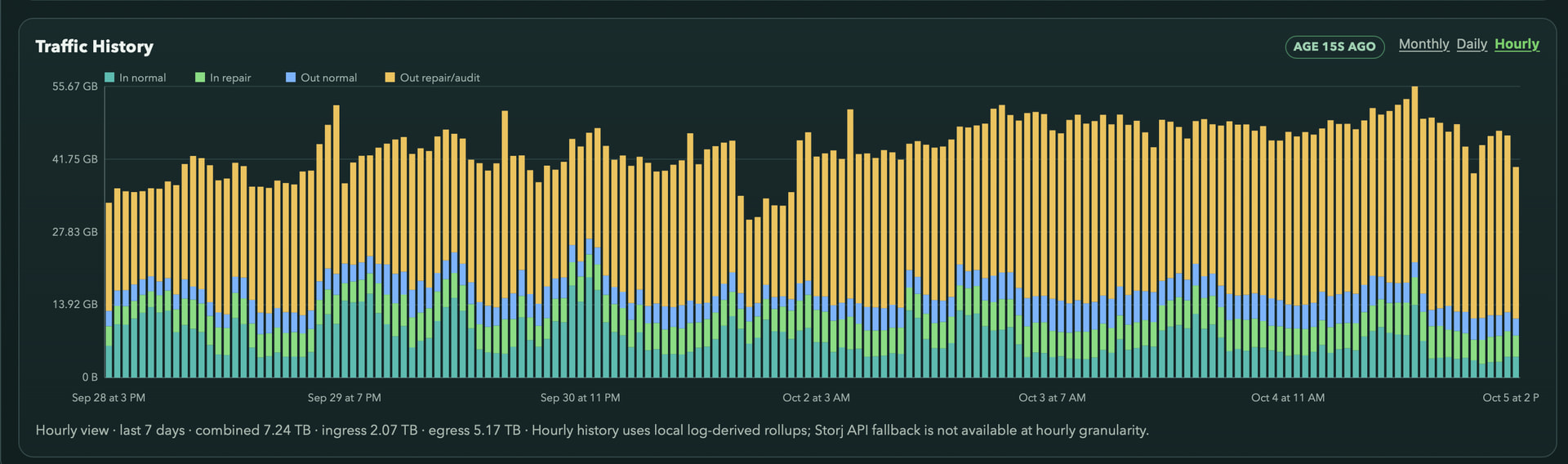
I’m wondering if I shall route nodes that are now connected via oracle with 10TB monthly traffic limit, through my home connection instead, as I don’t have any other choice for those nodes, they are behind nat. This would be bonkers, and I’m not looking forward that. 
Preempting the question “What, you don’t want traffic?” – No, I’d rather see customer traffic blow though 10TB monthly, and not repairs that are 5x of all the rest of traffic combined.
You should be able to use the Linux traffic control “tc” command to cap your outbound speed for awhile. You’ll lose some races… but otherwise the node will run properly and you can avoid blowing your 10TB cap.
Actually, excellent idea. I can setup the base rate to be 30Mbps, which is within ToS (25 down + 5 up), and yields 9TB/month, under 10TiB allocation.
And then if less is used – credit can accumulate to allow faster transfers until it’s exhausted. That way minimum QoS is retained, ToS unbroken, and my home IPS not angry at me.
I’ll ask my matrix friend to prototype this. Thank you!.
Or you could just upgrade from the free accounts, and pay for the egress, you would still profit entire DOLLARS on DOLLARS!
2 cents,
Julio
$8.50/TB!? I will never recover from it financially.
LMAO…
I feel better knowing that.
2 cents,
Julio
Without repairs there will be no customers in future 
I ran some satellite stats a few days ago and the overall expansion factor was 1.75 (29 of 50.6)
It was lower 2026-10-06T00:00:00Z:
Satellite ap1
---------------
      User storage:  0.708 PB (708100875403242 bytes)
  Expanded storage:  0.933 PB (932626849477456 bytes)
  Expansion factor: 1.32 (29 of 38.2), target is 54
--
Satellite us1
---------------
      User storage: 40.371 PB (40370596102509439 bytes)
  Expanded storage: 55.996 PB (55995671644553480 bytes)
  Expansion factor: 1.39 (29 of 40.2), target is 54
--
Satellite eu1
---------------
      User storage:  5.777 PB (5777181340398624 bytes)
  Expanded storage:  8.386 PB (8385501650311556 bytes)
  Expansion factor: 1.45 (29 of 42.1), target is 54
--
Satellite saltlake
---------------
      User storage:  0.280 PB (280417872771285 bytes)
  Expanded storage:  0.381 PB (380941720896671 bytes)
  Expansion factor: 1.36 (29 of 39.4), target is 54
--
Satellite Total
---------------
      User storage: 47.136 PB (47136296191082590 bytes)
  Expanded storage: 65.695 PB (65694741865239163 bytes)
  Expansion factor: 1.39 (29 of 40.4), target is 54
Today, about 15 hours later:
Satellite ap1
---------------
      User storage:  0.704 PB (704058301191980 bytes)
  Expanded storage:  1.020 PB (1019942013198354 bytes)
  Expansion factor: 1.45 (29 of 42.0), target is 54
--
Satellite us1
---------------
      User storage: 39.944 PB (39944495720029308 bytes)
  Expanded storage: 58.879 PB (58878970668748120 bytes)
  Expansion factor: 1.47 (29 of 42.7), target is 54
--
Satellite eu1
---------------
      User storage:  5.657 PB (5656639165928859 bytes)
  Expanded storage:  8.932 PB (8932063547714340 bytes)
  Expansion factor: 1.58 (29 of 45.8), target is 54
--
Satellite saltlake
---------------
      User storage:  0.280 PB (280416967414485 bytes)
  Expanded storage:  0.435 PB (435345704499197 bytes)
  Expansion factor: 1.55 (29 of 45.0), target is 54
--
Satellite Total
---------------
      User storage: 46.586 PB (46585610154564632 bytes)
  Expanded storage: 69.266 PB (69266321934160011 bytes)
  Expansion factor: 1.49 (29 of 43.1), target is 54
At this rate it has about 55-60 hours of repair, or longer, depending on node exits.
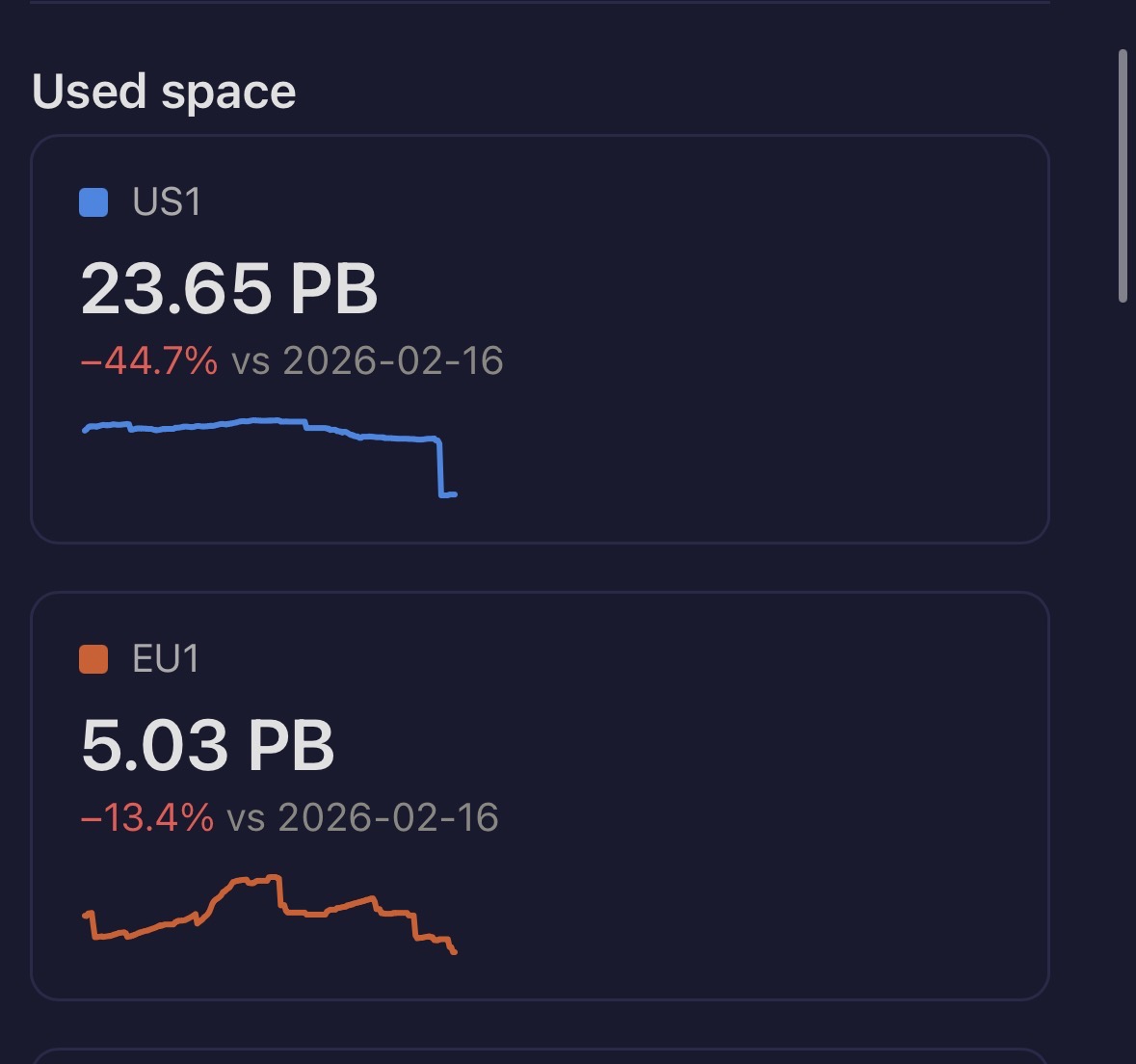

I get the joke: but others may not have seen US1 was split in two (and capacity went into US1-select)… which makes it look like US1 capacity went-off-a-cliff… when it simply moved.
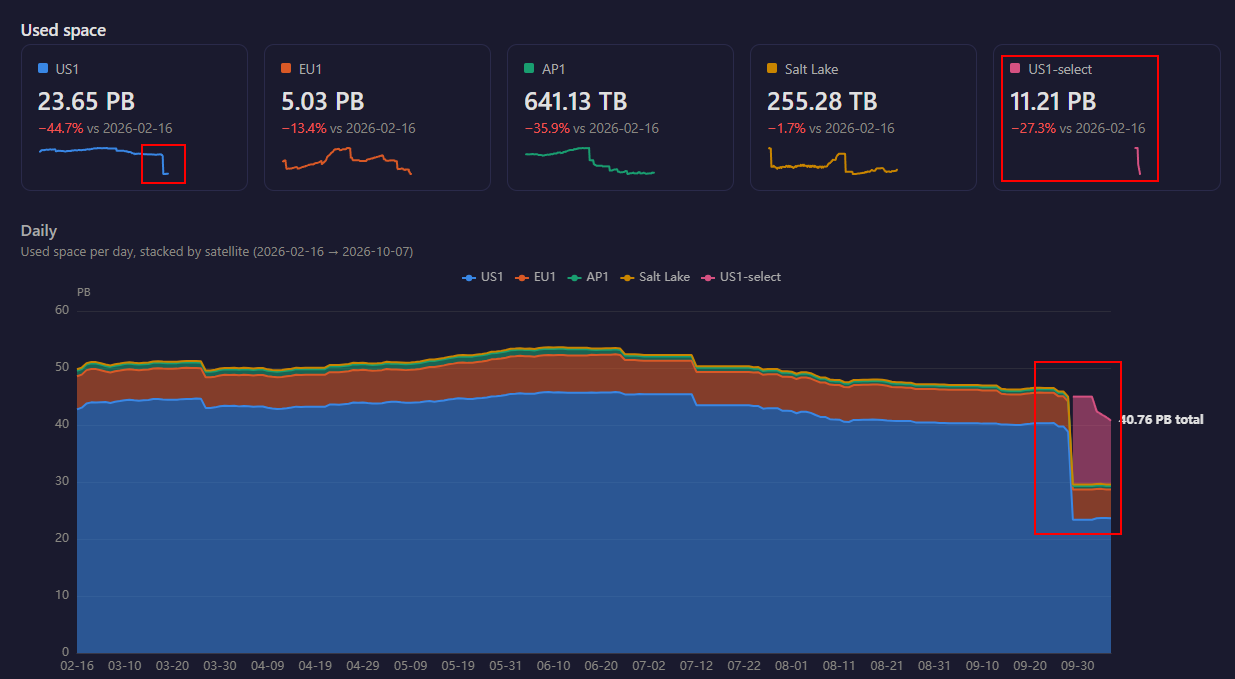
But still, the network has been on a slow slide for months, and Select recently took a hit too.